
A Child Learns Early
Perhaps an asterisk now that I'm 80

After my cousin Lewis died last month, I went looking for a certain photo of the two of us, me at five and my cousin at 17, both beaming. I couldn’t find the photo and this deepened the sadness I felt at not seeing him for several years before his death. There was no funeral, no shiva. Lewis just vanished. But what did surface in my searching in boxes of snapshots and old albums was an awareness of a particular aspect of the culture we grew up in, my cousin and I, that I don’t often think about. I came across an unfamiliar picture. This image, shared below, tells me a good deal about what I need to know about the America I lived in as a small child in 1946. Here I am on the Upper West Side, the very white very blonde child with the Shirley Temple curls, selecting a snack offered by her glamorous mother squatting on the sidewalk. I am wearing a bib. Clean was highly regarded. Clean was essential. I do not remember getting dirty except for the occasional knee scrape if I fell on the gravel in the playground. But I rarely fell because I rarely played. I was watched vigilantly by someone like the large black woman standing against the limestone wall in the photograph. This woman, our maid at that time whose name I don’t remember, is looking off in the distance as if she’s either not interested in the interchange between my mother and myself or she’s trying to disappear. I don’t really belong in this picture, she seems to be saying. I’m invisible like a waiter in a Chinese restaurant staring into space while the customers try to decide what soup to order for lunch.
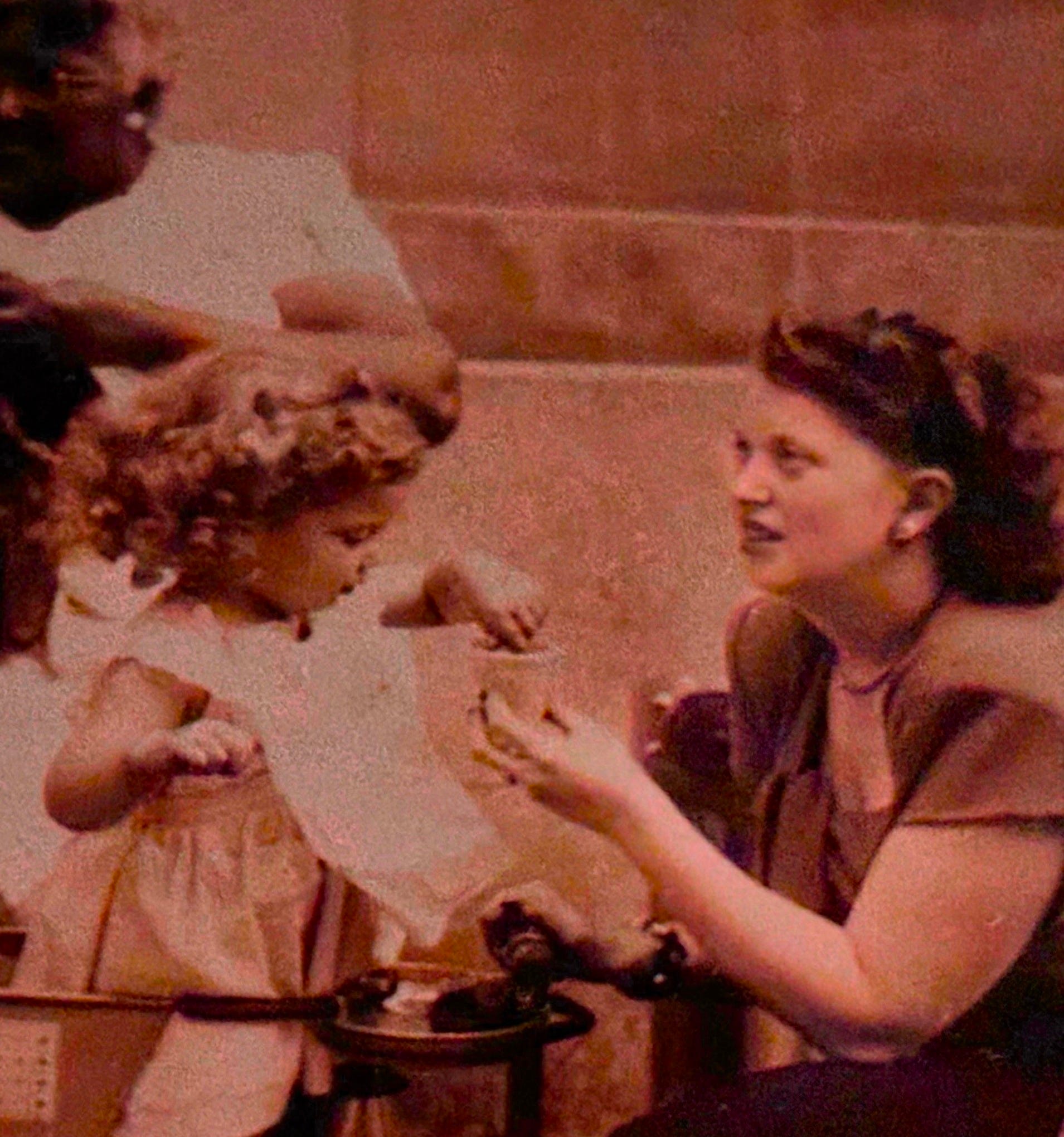
We took the fact that black people did our domestic labor for granted, not really giving the whole thing that much thought. They were just there. We had maids, just the way we had ice cream for dessert. It was as if it were perfectly natural for women to leave their own families to come down from Harlem to wax our floors, add bleach to our wash to make white even whiter. This is what people like us did. This is what Jewish people did in the comfort of post-Holocaust New York. We engaged these others to scrub the grime of not belonging out of our linens, our clothes, our toilets so that we would be Dick and Jane perfect, movie star perfect like my mother in the photo. So that Dachau would be forgotten, so that our own people’s experience of near erasure would fade from memory and we would advance to the front of the line in the new American postwar paradise. On the plantation, we gave grocery bags full of old clothes to our maids and spoke admiringly of Marian Anderson and Ralph Bunche. Poverty was not on our radar. They came to our houses, folded our underwear and overheard our arguments, going upstairs in the service elevator and entering the apartment through the back door. But we did not go to their houses. When we drove through Harlem on the way uptown to the George Washington bridge, we locked our car doors until New Jersey was safely in sight. We stared at the people on the street as we drove by as if they were tourist attractions. Large women in tight dresses out on the stoops, men in hats standing in doorways with cigarettes dangling from their mouths two miles from where I was raised in starched rectitude.
My parents were both active in liberal causes. This made their willful blindness about race particularly painful for me as a child. I carry the memory of the uniformed black maids watching their white charges in the playground in Riverside Park very deep inside of me. It isn’t a museum with displays about race relations interspersed with videos of civil rights marches. It isn’t a textbook with excerpts of the writings of MLK and Malcolm X. It’s me taking a cookie and a glass of very white milk from a very black maid at the gray formica table in the kitchen on 83rd street. It’s me seeing her arrive after her long bus ride in the morning and leave after work in the evening, weary, preoccupied with her own unimaginable life. Where were her children? Where was her mother?
*************************************************************************************************************Many Voices will now accept contributions from all subscribers. At this critical time, we need to hear what everyone has to say. Please let me know if you have work that you would like to send to seventysomething for our Many Voices feature. Make your voice heard. Write to me at seventysomething9@gmail.com.
Please consider upgrading to a paid subscription to support seventysomething and have access to the archives. Your ideas are always welcome.
*************************************************************************************************************Copies of my 2019 essay collection, Twilight Time: Aging in Amazement, are available directly from me (signed) or from your local bookseller.

I related to your beautifully written piece, Susie. In 1943, my Jewish parents hired a 16-year-old black woman to do housework and watch over my three older sisters, Judy, Jane and Joan. Her name was Catherine Maclin.
She became indispensable to our family. She was intelligent, loving and caring.
When I was born in 1947, she took over from my mother in my upbringing, introducing me to the library and the city where we lived.
I adored her. One of my nieces named her child after Catherine. She remained with our family until 1990, when my mom passed away. Of course, I have no doubt about my parents holding some racist ideas. But I so appreciate the opportunity to write about Catherine, who was my “second mother.”
Glad I didn't miss this one. It tore my heart with its raw racism and post-Holocaust Jewish privilege. Your vision is so deep and real, Susie - that's what I love most about you . . . saying it like it is and in a way that I can see (and I hope others see too).